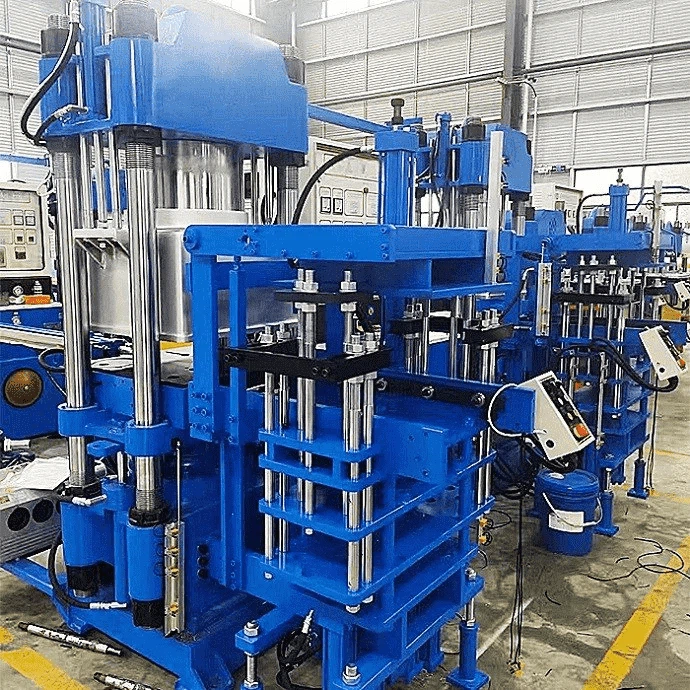
Rubber vulcanizing press are one of the most important pieces of equipment used in manufacturing rubber products. The Rubber vulcanizing press machine is a key piece of equipment in the rubber and elastomer industry. It determines the performance level of the finished product. Initial processes like mixing, pressing and extrusion produce only semi-finished materials. Only through the cross-linking reactions completed by the machine under high temperatures, high pressures, and controlled times can the rubber molecular structures change from linear into network-like. This results in a final product that is strong, elastic, and durable.
I. Basic Functions and Technological Value
Carrying out the vulcanization reaction
Vulcanizing press operate under conditions of high temperature and pressure within their mold cavity, leading to cross-linking within rubber compounds' vulcanization systems and increased strength, wear resistance, age resistance, recovery elasticity, as well as improved wear resistance, age resistance, recovery elasticity. Tires, conveyor belts, and gaskets all have strict mechanical specifications, with temperature, pressure, time strategies having an immense influence over these products' final characteristics.
Adapting to multiple types of rubber systems
Rubber vulcanizing press machine are suitable for general rubbers such as natural rubber and styrene-butadiene rubber, as well as special elastomers such as silicone rubber. By configuring the mold structure, heating method, and control logic, they can support various market demands ranging from general industrial products to medical and food-grade seals.
Supporting automated batch production
High-efficiency Rubber Vulcanizing Press Machine typically integrate functions such as timed mold closing, automatic pressure replenishment, and closed-loop temperature control, ensuring a stable production rhythm and consistent product quality. By connecting with upstream feeding systems and downstream demolding and online inspection systems, they can form automated, less labor-intensive rubber product production lines.
II. Process Optimization and Extended Applications
In practical applications, process control of the vulcanizing machine mainly focuses on precise management of the three parameters of temperature, pressure, and time:
- By adjusting the vulcanization temperature curve, it is possible to balance vulcanization speed and the risk of carbonization, while also taking into account production efficiency and quality risk control;
- By setting appropriate mold internal pressure and pressure replenishment strategies, the density and dimensional stability of the products can be improved, and defects such as bubbles and material shortages can be reduced;
- By precisely controlling the vulcanization time, insufficient or excessive vulcanization can be avoided, ensuring that the products reach the performance peak designed by the formulation.
Some equipment uses heat transfer oil or steam as the heating medium and combines automatic temperature control with zone heating to achieve energy optimization and improved thermal efficiency. Under the current background of "dual-carbon" goals and energy-saving constraints, energy-efficient vulcanizing machines have gradually become an important consideration in equipment selection.
III. Key Equipment Types and Applicable Scenarios
Typical rubber vulcanization equipment can be differentiated based on structure and application scenarios:
Flat vulcanizing press machine
With uniform high pressure and a planar mold cavity, it is suitable for continuous or batch vulcanization of flat or nearly flat products such as conveyor belts, flat rubber sheets, and transmission belts, emphasizing pressure uniformity and product thickness consistency.
Silicone Rubber Special vulcanizing press machine
Equipped with high precision and multi-point temperature control capabilities, in combination with clean processes and strict hygiene standards, it is suitable for molding high-cleanliness and high-stability products such as medical-grade silicone products and food-grade sealing rings.
Four-column vulcanizing press machine
With good rigidity and uniform force distribution, it is suitable for products with metal frameworks, inserts, or complex multi-layer structures, such as shock absorbers and industrial accessories. It can maintain mold alignment and product accuracy under large mold sizes and high-tonnage pressure.
Tire Special vulcanizing press machine
Integrated with automatic tire mounting, tire removal, and multi-station linkage technology, it realizes efficient vulcanization and molding of the tire body and tread within the mold, and is one of the core types of equipment for high-capacity tire factories producing passenger car tires and engineering tires.
IV. Industry Development Trends
Driven by industry upgrading and increased customer demands, the technological evolution of rubber vulcanizing presss mainly focuses on the following directions:
- Intelligence and Visualization: Incorporating functions such as recipe management, process curve traceability, and equipment status monitoring, enabling process data recording and quality tracking;
- High Efficiency and Energy Saving: Optimizing the heating system, insulation structure, and control logic to reduce energy consumption per unit of product;
- Safety and Environmental Protection: Enhancing multi-level safety protection across mechanical, electrical, and control systems, combined with waste gas treatment and noise control, to meet safe production and environmental compliance requirements.
In conclusion, the rubber vulcanizing press is not only essential equipment on the rubber product production line, but also a crucial hub connecting formulation design, process engineering, and final product performance. Its configuration and process level directly determine the product competitiveness and manufacturing cost structure of the enterprise.